You built your Cleveland contracting or service business from the ground up, and now the phone is ringing more than ever but every missed call is a missed job. Hiring a receptionist feels like the obvious fix until you see the true cost of salary, benefits, payroll taxes, and turnover staring back at you. In 2025, a growing number of service businesses across Cleveland, Strongsville, and the surrounding metro are turning to AI automation not because it is trendy, but because the math is hard to argue with. In this breakdown, you will learn exactly what both options cost, where AI delivers returns most people never expect, where it falls short, and how to decide which approach actually fits where your business is right now.
The Real Question Cleveland Contractors Are Asking in 2025
It's a Tuesday afternoon in February, and a two-man HVAC crew is knocking out a furnace replacement in Parma. The owner's phone rings three times while he's under the unit. He calls back two hours later. Two of those callers had already booked with someone else.
That's not a bad-luck story. That's a revenue leak happening to Cleveland service businesses every single week, across HVAC, plumbing, electrical, roofing, and landscaping. And it raises a question that more contractors are wrestling with in 2025: do you hire someone to handle the phones and admin, or do you automate it?
For years, the answer was automatic: hire a receptionist or an office admin. But that math is shifting fast. Labor costs in Northeast Ohio have climbed, turnover in small service businesses is brutal, and a human hire still leaves your phones dark after 5pm. The AI vs hiring staff small business decision is no longer a tech-forward experiment. It's a practical calculation that affects how much revenue you capture and how much overhead you carry. This article breaks it down honestly, starting with what each option actually costs.
What It Actually Costs to Hire a Receptionist or Admin in Cleveland

So let's start with the number most Cleveland contractors actually see: the job posting. An entry-level receptionist or admin in the Cleveland metro area typically lists at $32,000 to $42,000 in base salary. That number feels manageable. It is also not the real number.
Once you account for the full cost of employment, that salary grows fast. Here is what a first-year hire actually costs a small service business in Northeast Ohio:
Base salary: $32,000–$42,000
FICA payroll taxes (7.65%): $2,450–$3,200
Health insurance (employer share): $6,000–$8,000
Workers compensation insurance: $800–$1,500 (higher for trades-adjacent roles)
Paid time off (10 days average): $1,200–$1,600 in lost coverage value
Recruiting costs: SHRM puts the average cost-per-hire at $4,700, and that holds in a mid-size market like Cleveland
Equipment, software, and onboarding: $1,500–$3,000 for the first year
Add it up and the realistic first-year total lands between $55,000 and $75,000, before you see a single dollar of productivity return on that hire.
And that is the optimistic scenario. Cleveland small service businesses face annual turnover rates of 25 to 40 percent in administrative roles. If that hire leaves at month eight, you absorb the recruiting and onboarding costs again. Retraining cycles eat owner time that should be going toward jobs and estimates.
There is also a ceiling built into every human hire that rarely gets discussed: a receptionist covers 8 to 9 hours a day, five days a week. Your phones go dark every evening, every weekend, and every sick day. For a plumber or HVAC contractor, that is exactly when customers need you most. If you want to understand how much missed calls are costing your business, the after-hours gap alone tells a significant part of the story.
What AI Automation Actually Costs for a Small Service Business
Now put that $55,000 to $75,000 number next to what AI automation actually costs for a small service business, and the comparison becomes hard to argue with.
AI tools for service businesses span a wide range: basic chatbots and call-routing software start around $50 per month, while enterprise-level platforms with deep CRM integration can run $1,500 per month or more. For an HVAC company, plumbing shop, landscaper, or electrical contractor in Northeast Ohio, neither extreme is the right frame. The relevant range is a purpose-built AI receptionist service that handles 24/7 call answering, appointment booking, and lead capture.
That typically runs $150 to $500 per month. Phoenix Callflow AI operates in this range, built specifically for the kind of service businesses where a missed call is a missed job.
Run the annual math:
| AI Receptionist Service | Full-Time Receptionist Hire |
|---|---|---|
Annual cost | $1,800 to $6,000 | $55,000 to $75,000 |
Hours covered | 24/7, 365 days | 8-9 hrs/day, 5 days/week |
Turnover risk | None | 25-40% annually in Cleveland |
Time to deploy | Days | Weeks to months |
The gap is not marginal. It is structural.
Research consistently shows AI handles 60 to 80 percent of what small businesses would hire administrative staff to do: answering inbound calls, qualifying leads, booking appointments, responding to common service questions, and capturing after-hours inquiries. That core workload gets covered at a fraction of the cost, with no overtime, no sick days, no retraining cycles, and no two-week notice.
When call volume spikes during Cleveland's spring HVAC tune-up season or after the first hard freeze, AI scales with it instantly. There is no scrambling to cover phones. To see how our AI receptionist works, the operational picture becomes clear quickly.
The Hidden ROI: Calls Answered at 2am on a Sunday in Strongsville
The cost comparison above is compelling on its own. But it understates the real case for AI answering, because it only counts savings. The bigger argument is about revenue you are capturing right now versus revenue that is walking out the door.
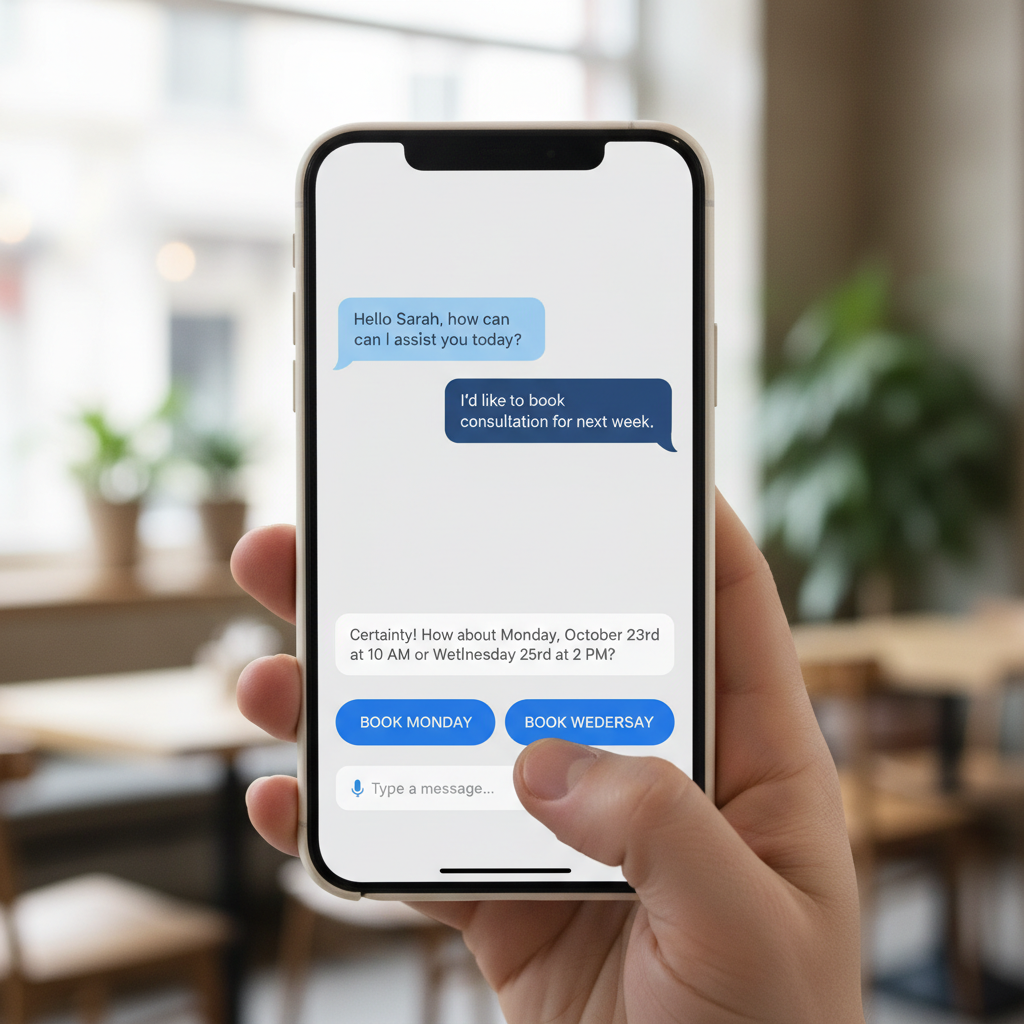
Consider a scenario that plays out in Northeast Ohio every winter. A homeowner in Strongsville loses heat at 11pm on a Sunday. The temperature is dropping toward single digits and they have kids in the house. They are not browsing reviews carefully. They are calling HVAC companies back to back until someone answers and gives them a path forward. The first company with an AI receptionist picks up immediately, books the appointment, and confirms the details. The other two companies get a voicemail. By the time those owners check messages Monday morning, the job is gone.
That is not a hypothetical edge case. It is the operating reality of weather-driven service industries in Cleveland. Furnace failures, burst pipes, emergency roof leaks, and ice dam calls do not arrive between 9am and 5pm on weekdays. They arrive at the worst possible moments, and they go to whoever responds first.
The data behind this is striking. Research consistently shows that businesses responding to a lead within five minutes are 100 times more likely to convert that lead compared to a 30-minute response. After-hours, that gap is even more pronounced because the competition drops to zero. A human receptionist cannot close that window. An AI answering service running at 2am on a Sunday can.
Run the revenue math on a single job. An emergency furnace repair or replacement in Strongsville averages $300 to $3,000 depending on the call. One booked appointment from an after-hours inquiry covers anywhere from one to twenty months of AI service cost. That is not cost avoidance. That is direct revenue capture that would not exist otherwise. If you want to put a sharper number on what unanswered calls are actually costing your business, how much missed calls are costing your business breaks it down concretely.
What AI Still Cannot Do: Knowing When to Keep a Human in the Loop
That revenue capture argument is real. But making an honest case for AI also means being direct about where it falls short, because the businesses that get the most out of automation are the ones that deploy it with clear eyes.
AI answering handles the front-line workload extremely well: inbound call intake, appointment scheduling, lead qualification, common service FAQs, and after-hours coverage. That is the 60 to 80 percent of call volume that follows predictable patterns. A customer needs a furnace tune-up in Westlake, wants to know your service area, or needs to reschedule a cleaning appointment. AI manages all of that without friction.
But there are situations where routing to a human is not just preferable, it is necessary. A homeowner whose basement is actively flooding is not looking for a calm, efficient intake process. They are panicked, and they need someone who can meet that urgency with genuine empathy. Research from Nextiva consistently identifies empathy and real-time judgment as the areas where human communication holds a clear advantage over automated systems. Complex pricing negotiations, highly customized job quotes, and long-term client relationships that carry history and nuance all fall into the same category.
For most Cleveland service businesses, the practical answer is a hybrid model. AI handles the front line around the clock, capturing every lead and booking every straightforward appointment. The owner or a part-time coordinator handles the calls that require judgment during business hours. That structure keeps overhead low while making sure no customer who genuinely needs a human voice gets handed off to a script. The goal is not to replace every human touchpoint. It is to stop wasting human time on work that does not require it.
AI vs. Hiring Staff: Side-by-Side Breakdown for Service Businesses

A hybrid model handles the operational nuance well. But before deciding how to structure that balance, it helps to see the full picture in one place. Here is how AI and a full-time staff hire compare across the six dimensions that matter most to a Cleveland service business.
Dimension | AI Receptionist Service | Full-Time Hire |
|---|---|---|
Annual Cost | $1,800 to $6,000 | $55,000 to $75,000 first-year true cost including taxes, insurance, recruiting, and equipment |
Availability | 24/7, every day including holidays | 8 to 9 hours per day, 5 days per week; phones go dark evenings, weekends, and sick days |
Consistency and Reliability | Identical response on every call, no bad days, no distracted handoffs | Varies by individual; quality dips during high-stress periods or when coverage is thin |
Time to Deploy | Days from signup to live answering | Weeks to months including recruiting, interviewing, onboarding, and training to your workflows |
Scalability During Busy Seasons | Instant; handles spring HVAC tune-up volume, fall furnace check surges, and summer landscaping demand with no added cost | Requires overtime, temp hires, or coverage gaps; Cleveland's seasonal spikes hit without warning |
Turnover Risk | Zero | 25 to 40 percent annual turnover in Cleveland admin roles; each departure resets recruiting and training costs |
The verdict on the AI vs hiring staff small business comparison shifts most sharply on two dimensions for Northeast Ohio contractors: scalability and availability. Cleveland's service calendar is not flat. A plumbing or HVAC business in October fields a fundamentally different call volume than it does in July. A human hire is a fixed resource against a variable demand curve. AI adjusts to that curve without friction, without overtime, and without a conversation about staffing up for a three-week rush.
When Hiring Staff Still Makes Sense for a Growing Cleveland Business
That side-by-side comparison favors AI heavily at the early and mid-growth stages. But the honest answer to the AI vs hiring staff small business question is that automation is not the permanent solution for every Cleveland contractor at every stage of growth.
There are real thresholds where a human hire starts making operational sense. If your inbound call volume consistently exceeds 60 to 80 calls per day, the complexity and volume of interactions may justify a dedicated coordinator. If you are running a team of 10 or more technicians who need daily scheduling, parts coordination, and job-site communication, an on-site admin becomes a logistics asset, not just a phone handler. And if your business model is built on deep, ongoing relationships with commercial clients or property management companies, a human who knows those accounts personally carries relationship value that AI does not replicate.
For Cleveland service businesses scaling from $500,000 toward $1 million in annual revenue, the most practical structure is often both: AI handling front-line call capture and after-hours coverage, with a part-time human coordinator managing job coordination and complex client follow-up during business hours. That combination keeps overhead manageable while covering the work that genuinely requires judgment.
AI is a strong starting point that removes the biggest cost and coverage gaps early. Get a free demo to see what that foundation looks like before deciding whether a hire fits into the next stage of your growth.
Deciding between expanding your workforce and implementing AI automation is a pivotal step for any Cleveland service business. While hiring provides a human touch, automation offers the scalability and consistency needed to stay competitive in today's digital landscape. Balancing these options ensures your operations remain agile without the overhead of traditional staffing. If you want expert help navigating these technological shifts, you can learn more about Phoenix Callflow AI+WEB on our About page to see how we support local growth.